Mostrar mensagens com a etiqueta Guerra Económica. Mostrar todas as mensagens

sábado, 5 de abril de 2025

Alain Juillet: ce que cache la stratégie de Trump...


La donne géopolitique a totalement changé: De la guerre économique couverte à la guerre économique ouverte


O ex-patrão da DGSE (a secreta francesa), o nosso velho amigo Alain Juillet, desmonta os mecanismos da análise da situação feita pela equipa Trump e põe a claro os objectivos da "estratégia Trump", tanto no plano interno como na ordem externa. Ou seja, fornece uma grelha de leitura que organiza, clarifica e permite entender o que, de outro modo, pode aparecer como um amontoado de confusões: "Com isto presente, compreende-se toda a política de Trump desde que ele chegou ao poder e o que ele vai fazer"... Nada do que esconde a "estratégia Trump" ficará por revelar.

Merci, M. Juillet

terça-feira, 1 de agosto de 2023

Uma Leitura Indispensável: Chinese Communist Espionage - An Intelligence Primer

Quando a China se posiciona para impor ao mundo uma outra ordem geopolítica, baseada no "modelo chinês", é tempo de perceber a estratégia de Pequim para alcançar a supremacia global. Este "Chinese Communist Espionage - An Intelligence Primer", de Peter Mattis e Matthew Brazil, é essencial para isso.


"This is the first book of its kind to employ hundreds of Chinese sources to explain the history and current state of Chinese Communist intelligence operations. It profiles the leaders, top spies, and important operations in the history of China's espionage organs, and links to an extensive online glossary of Chinese language intelligence and security terms. Peter Mattis and Matthew Brazil present an unprecedented look into the murky world of Chinese espionage both past and present, enabling a better understanding of how pervasive and important its influence is, both in China and abroad."


Chinese Espionage Terms
and photos on CCP intelligence history.

sexta-feira, 19 de maio de 2023

Nova Guerra Fria abre Era de Geoeconomia

The Economic Consequences of a new Cold War

Geopolitics is reshaping the global economy, and will do some for the foreseeable future. We have indeed entered an era of “geo-economics.”


The growing geopolitical tensions between China, The United States and Europe have given rise to a whole new vocabulary: National security, decoupling, de-risking, onshoring, friend-shoring, near-shoring, and Cold War II are now the talk of the town...

Depending how the balance of national security and economy is struck in the end, the damage can be considerable, and even catastrophic.

Not your grandfather’s cold war

A new cold war, if it ends that way, will be very different from the last one. The Soviet Union and its COMECON allies hardly had any interaction with the west, and even that was focused on commodities, such as the grain-for-oil deals between the USSR and the United States. Trade with the USSR never amounted to more than 2 percent of the OECD’s total trade.

In contrast, China today is a key note in global supply chains, supplies some 20 percent of imports of advanced economies, and is increasingly a supplier of intermediaries to other countries, notably in South East Asia. This means that global supply chains increasingly depend on inputs from China, from rare earths to batteries to machine tools.

Furthermore, China is becoming more and more a source new technologies, innovation and ideas, produced by the millions of STEM students graduating every year, and the hundreds of thousands of PhDs, many of them studying and working at universities in the west. In peaceful times, this is a source of great benefits to the world, but in times of tension it is seen as a worrisome gain in capacity of a potential adversary.

The end of the first cold war also meant a large “peace dividend” of reduced spending on the military. According to numbers of Stockholm-based SIPRI, military spending as a share of global GDP fell from 6 percent of global output in the 1960s at the peak of the cold war to 2.1 percent in 20221. The same national security concerns that are reshaping global value chains could lead to increased military spending. (.....)

All of this still leaves aside a possible upturn in military spending. In the wake of Russia’s invasion of Ukraine, many European NATO members are now considering upping their spending to the NATO norm of 2 percent of GDP, and in addition, Germany has announced a special allocation of EUR100bn. to refurbish their military. Japan has committed to increase its spending to 2 percent of GDP by 2027, an increase of 60 percent. World military spending overall grew by 3.7 percent in real terms in 2022, the highest level ever recorded by SIPRI, which has numbers dating back to 1949.

Irrespective how long green lists are, or how small the yards with high fences without a restoration of some level of trust between the US and Europe on the one hand, and China on the other, as I argued almost 3 years ago. If a country cannot be certain of supplies of critical goods from one country, it will seek to diversify away from the most efficient supplier, and choose an ally to supply it, or reshore production altogether, irrespective of the efficiency losses. If a country cannot be assured of access to critical technologies, it will choose to invent it itself, irrespective of the duplication involved.

Strategic Trust as Vivian Balakrishnan called it recently in a speech at the ANU is the glue that keeps the global order from disintegrating. If a country cannot be reasonably certain that it can import the critical goods and technology it needs, that country will strive to make it itself.

This classic prisoners’ dilemma will result in a world of trade blocks, and all will be worse off than today.

https://berthofman.substack.com/p/the-economic-consequences-of-a-new


quarta-feira, 10 de maio de 2023

O "Novo Consenso de Washington" ou o Enterro do Neo-Liberalismo

Trump conquistou o poder com um "Make América Great Again" que foi o toque de finados da "globalização" e da sua apologética narrativa "neo-liberal". Trump tinha sabido envergar e muito bem vender o discurso político (elaborado por Steve Bannon) que fazia o encontro entre uma emergente e nova racionalidade geopolítica e as angústias da maior minoria americana, os trabalhadores brancos ou, no dizer da senhora Clinton, os "deploráveis", também ditos em linguajar de sociólogo, os "white trash". Ninguém quis perguntar, na altura, por quem dobravam os sinos. Era mais fácil atribuir a "inesperada" vitória de Trump a uma "conspiração russa". Eleito Biden, muita gente tomou a nuvem por Juno ou os seus desejos pela realidade e "achou" que esta vitória do candidato do PD era um retorno ao pré-Trump. Enganaram-se, claro.

Joe Biden prosseguiu e desenvolveu a política MAGA de Trump mas mudando-lhe a imagem: vestiu-lhe uma roupagem sexy e estampou-lhe um sorriso na cara. Assim, continuou a fatal erosão do velho "consenso de Washinton", que vinha dos anos 80 do século passado com as suas narrativas da globalização produtora de felicidade e do neo-liberalismo produtor de racionalidade económica. A oração fúnebre foi agora rezada pelo National Security Adviser do Presidente Biden, Jake Sullivan, que, enquanto enterrava o velho "consenso", aproveitou para apresentar o novo.

The New Washington Consensus

Franklin Foer | The Atlantic | May 10, 2023

Earlier this month, National Security Adviser Jake Sullivan delivered a speech at the Brookings Institution that historically would have made for front-page material but barely registered in the world beyond wonkdom. His address was a muscular statement of ideological intent.

Jake Sullivan (National Security Adviser, do Presidente Biden)

He argued that President Joe Biden’s agenda channeled a set of ideas Sullivan called the “new Washington consensus.” There was a bit of cheek in his use of that term. The Washington Consensus was a phrase that entered circulation at the very end of the 1980s, describing the emerging bipartisan faith in globalization, deregulation, and the wisdom of markets, suited to an era of optimistic triumphalism. But that era is ending. Or, as Sullivan put it, “The last few decades revealed cracks in those foundations.”

What Sullivan championed in the speech was something like the antithesis of that old paradigm. He said that ever-greater global interdependence is no longer desirable. One reason is China, which participates in global capitalism without fairly playing by its rules. Another is the realization, exposed by the pandemic-induced crisis in the intricate global supply chain, that the American economy is vulnerable to even small disruptions on the other side of the planet. That crisis was an indication that the world has gone too far in a libertarian direction and needs the sort of regulation and government investment that only a short while ago were highly unfashionable in the Washington policy sphere.

Although he didn’t justify his use of the term this way, he could get away with describing his views as representative of a new “consensus”: Both Trump and Biden have positioned themselves as economic nationalists, self-consciously abandoning the precepts of the old order.

That’s not to describe the Trump and Biden versions of economic nationalism as equivalent.  Although Trump delivered vituperative speeches, inflected by xenophobia, about elites destroying American manufacturing, he didn’t really have any ideas about how to reverse course beyond jacking up tariffs. Biden’s national-security adviser, by contrast, put a big idea at the center of his speech. He extolled the virtues of industrial strategy: a new role for the state in directing the trajectory of the economy.

Industrial strategy begins with the premise that the national interest demands that certain industries flourish domestically. .....

https://www.msn.com/en-us/money/markets/the-new-washington-consensus/ar-AA1aWvVE

quarta-feira, 3 de maio de 2023

Quando o BCE reconhece a "nova realidade geopolítica"

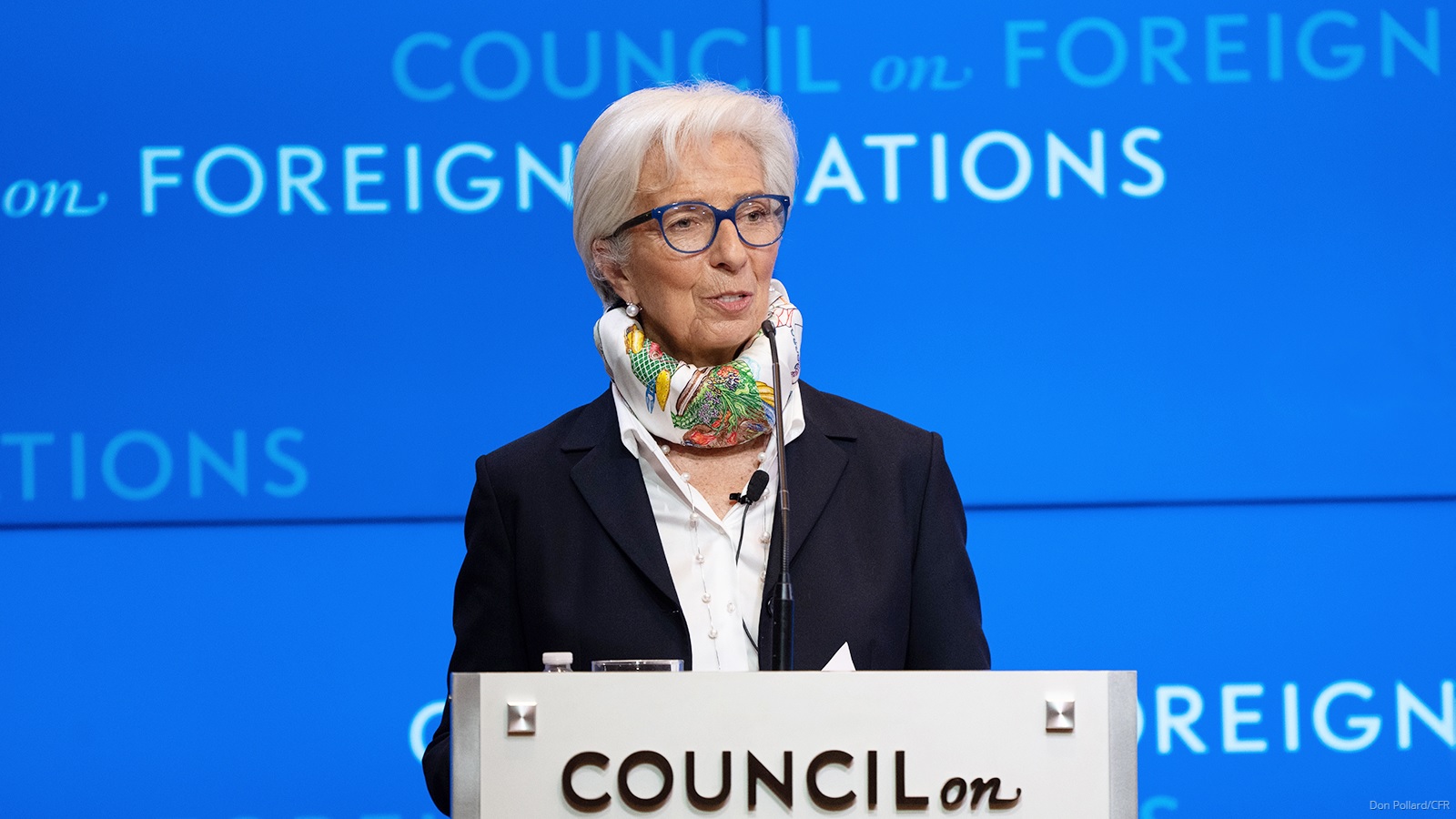
Christine Lagarde, a directora do BCE, Banco Central Europeu, pronunciou recentemente, em New York, perante o CFR, Council of Foreign Relations, um importante discurso que aqui se regista, na integra, antecedido por uma síntese do comentário de Bruno Bertez. Lagarde reconhece que a geopolítica assumiu o comando das dinâmicas mundiais(que estão a transformar de cima a baixo o sistema global), procura estabelecer o que isso significa e as suas consequências. De facto, é a primeira vez que a 'patroa' do BCE reconhece que as crescentes rivalidades e tensões geopolíticas exercem uma sobredeterminação sobre as instâncias económicas. "A new geopolitical reality may well lie ahead, which could have profound implications for central bank policymaking." O dedo de Putin (e de outros...) passou pela cabeça de Christine Lagarde...


Vers la Fin de L’Hégémonie Occidentale?


Bruno Bertez | Paris | 28 avril 2023

Christine Lagarde a «analysé» les développements récents du commerce et de l’investissement mondiaux, et elle a évalué les implications de la contestation apparente de la domination hégémonique de l’économie américaine et du dollar dans l’économie mondiale.

«L’économie mondiale a traversé une période de changement transformateur. Suite à la pandémie, la guerre injustifiée de la Russie contre l’Ukraine, la militarisation de l’énergie, l’accélération soudaine de l’inflation, ainsi qu’une rivalité croissante entre les États-Unis et la Chine, les plaques tectoniques de la géopolitique se déplacent plus rapidement.»

Le dernier âge d’or

Elle a parlé avec nostalgie de la période post-1990 après l’effondrement de l’Union soviétique:

«Dans la période qui a suivi la guerre froide, le monde a bénéficié d’un environnement géopolitique remarquablement favorable. Sous la direction hégémonique des États-Unis, les institutions internationales fondées sur des règles ont prospéré et le commerce mondial s’est développé. Cela a conduit à un approfondissement des chaînes de valeur mondiales et, à mesure que la Chine rejoignait l’économie mondiale, à une augmentation massive de l’offre mondiale de main-d’œuvre.»

Oui, c’était l’époque de la vague de mondialisation, de l’augmentation des échanges et des flux de capitaux libres; la domination des institutions de Bretton Woods comme le FMI et la Banque mondiale dictant les conditions de crédit; et surtout, l’espoir que la Chine serait placée sous contrôle après son adhésion à l’Organisation mondiale du commerce (OMC) en 2001.

Cependant, rien n’a fonctionné comme prévu.

Le pari occidental était idéologique, les penseurs stratégiques étaient persuadés que grâce à son insertion dans le marché mondial, la Chine allait se banaliser, allait rentrer dans le moule et qu’ainsi elle allait obéir aux fameuses règles.

Que nenni! La vague de mondialisation heureuse a pris fin en 2008 après la crise et la Grande Récession, et la Chine n’a pas joué le jeu en ouvrant son économie aux multinationales occidentales.

Cela a forcé les Etats-Unis à changer de politique vis-à-vis de la Chine et à passer de «l’engagement positif» à «l’endiguement négatif».

Puis vint l’invasion russe de l’Ukraine et la détermination renouvelée des Etats-Unis et de leurs "satellites/vassaux" européens d’étendre leur contrôle vers l’est et de s’assurer ainsi que la Russie échoue dans sa tentative d’exercer un contrôle sur ses voisins frontaliers.

Ce qui était bon

Lagarde commente les implications économiques:

«Mais cette période de stabilité relative peut maintenant céder la place à une instabilité durable entraînant une croissance plus faible, des coûts plus élevés et des partenariats commerciaux plus incertains. Au lieu d’une offre mondiale plus élastique, nous pourrions faire face au risque de chocs d’approvisionnement répétés.»

En d’autres termes, la mondialisation et la circulation aisée du commerce et des flux de capitaux qui ont tant profité au bloc occidental, c’est fini.

Tout ce qui était bon avant, souhaitable dans le cadre de la mondialisation, tant qu’elle profitait à l’Occident, c’est terminé. La religion du libre-échange, de l’ouverture des frontières s’évanouit car elle a fini par profiter à d’autres! Il faut revenir aux mesures protectionnistes (augmentation des tarifs, etc.) au contrôle du commerce, surtout technologique, et tenter d’inverser la mondialisation en un capital de «reshoring» (relocalisation) ou «friendshoring» (amicalocalisation).

«Dans la mesure où la géopolitique conduit à une fragmentation de l’économie mondiale en blocs concurrents, cela appelle une plus grande cohésion politique. Ne pas compromettre l’indépendance, mais reconnaître l’interdépendance entre les politiques et la meilleure façon dont chacune peut atteindre son objectif si elle est alignée sur un objectif stratégique.»


Speech by Christine Lagarde, President of the ECB, at the Council on Foreign Relations’ C. Peter McColough Series on International Economics

New York, 17 April 2023

It is a pleasure to be here in New York.

The global economy has been undergoing a period of transformative change. Following the pandemic, Russia’s unjustified war against Ukraine, the weaponisation of energy, the sudden acceleration of inflation, as well as a growing rivalry between the United States and China, the tectonic plates of geopolitics are shifting faster.

We are witnessing a fragmentation of the global economy into competing blocs, with each bloc trying to pull as much of the rest of the world closer to its respective strategic interests and shared values. And this fragmentation may well coalesce around two blocs led respectively by the two largest economies in the world.

All this could have far-reaching implications across many domains of policymaking. And today in my remarks, I would like to explore what the implications might be for central banks.

In short, we could see two profound effects on the policy environment for central banks: first, we may see more instability as global supply elasticity wanes; and second, we could see more multipolarity as geopolitical tensions continue to mount.

A changing global economy

In the time after the Cold War, the world benefited from a remarkably favourable geopolitical environment. Under the hegemonic leadership of the United States, rules-based international institutions flourished and global trade expanded. This led to a deepening of global value chains and, as China joined the world economy, a massive increase in the global labour supply.

As a result, global supply became more elastic to changes in domestic demand, leading to a long period of relatively low and stable inflation.[1] That in turn underpinned a policy framework in which independent central banks could focus on stabilising inflation by steering demand without having to pay too much attention to supply-side disruptions.[2]

But that period of relative stability may now be giving way to one of lasting instability resulting in lower growth, higher costs and more uncertain trade partnerships. Instead of more elastic global supply, we could face the risk of repeated supply shocks. Recent events have laid bare the extent to which critical supplies depend on stable global conditions.

That has been most visible in the European energy crisis, but it extends to other critical supplies as well. Today the United States is completely dependent on imports for at least 14 critical minerals.[3] And Europe depends on China for 98% of its rare earth supply.[4] Supply disruptions on these fronts could affect critical sectors in the economy, such as the automobile industry and its transition to electric vehicle production.

In response, governments are legislating to increase supply security, notably through the Inflation Reduction Act in the United States and the strategic autonomy agenda in Europe. But that could, in turn, accelerate fragmentation as firms also adjust in anticipation. Indeed, in the wake of the Russian invasion of Ukraine, the share of global firms planning to regionalise their supply chain almost doubled – to around 45% – compared with a year earlier.[5]

This “new global map” – as I have called these changes elsewhere[6] – is likely to have first-order implications for central banks.

One recent study based on data since 1900 finds that geopolitical risks led to high inflation, lower economic activity and a fall in international trade.[7] And ECB analysis suggests similar outcomes may be expected for the future. If global value chains fragment along geopolitical lines, the increase in the global level of consumer prices could range between around 5% in the short run and roughly 1% in the long run.[8]

These changes also suggest that a second shift in the central bank landscape is taking place: we may see the world becoming more multipolar.

During the Pax Americana after 1945, the US dollar became firmly ensconced as the global reserve and transaction currency, and more recently, the euro has risen to second place.[9] This had a range of − mostly beneficial − implications for central banks. For example, the ability of central banks to act as the “conductor of the international orchestra” as noted by Keynes, or even firms being able to invoice in their domestic currencies, which made import prices more stable.[10]

In parallel, Western payments infrastructures assumed an increasingly global role.

For instance, in the decade after the Berlin Wall fell, the number of countries using the payments messaging network SWIFT more than doubled.[11] And by 2020, over 90% of cross-border transmissions were being signalled through SWIFT.[12]

But new trade patterns may have ramifications for payments and international currency reserves.

In recent decades China has already increased over 130-fold its bilateral trade in goods with emerging markets and developing economies, with the country also becoming the world’s top exporter.[13] And recent research indicates there is a significant correlation between a country’s trade with China and its holdings of renminbi as reserves.[14] New trade patterns may also lead to new alliances. One study finds that alliances can increase the share of a currency in the partner’s reserve holdings by roughly 30 percentage points.[15]

All this could create an opportunity for certain countries seeking to reduce their dependency on Western payment systems and currency frameworks – be that for reasons of political preference, financial dependencies, or because of the use of financial sanctions in the past decade.[16]

Anecdotal evidence, including official statements, suggests that some countries intend to increase their use of alternatives to major traditional currencies for invoicing international trade, such as the Chinese renminbi or the Indian rupee.[17] We are also seeing increased accumulation of gold as an alternative reserve asset, possibly driven by countries with closer geopolitical ties to China and Russia.[18]

There are also attempts to create alternatives to SWIFT. Since 2014, Russia has developed such a system for domestic and cross-border use, with over 50 banks across a dozen countries using it last year.[19] And since 2015 China has established its own system to clear payments in renminbi.

These developments do not point to any imminent loss of dominance for the US dollar or the euro. So far, the data do not show substantial changes in the use of international currencies. But they do suggest that international currency status should no longer be taken for granted.

Policy frameworks for a fragmenting world

How should central banks respond to these twin challenges?

We have clear examples of what not to do when faced with a sudden increase in volatility. In the 1970s, central banks faced upheaval in the geopolitical environment as OPEC became more assertive and energy prices that had been stable for decades ballooned. They failed to provide an anchor of monetary stability and inflation expectations de-anchored – a mistake that should never be repeated for as long as central banks are independent and have clear price stability mandates.

So, if faced with persistent supply shocks, independent central banks can and will go ahead with ensuring price stability. But this can be achieved at a lower cost if other policies are cooperative and help replenish supply capacity.

For example, if fiscal and structural policies focus on removing supply constraints created by the new geopolitics – such as securing resilient supply chains or diversifying energy production – we could then see a virtuous circle of lower volatility, lower inflation, higher investment, and higher growth. But if fiscal policy instead focuses mainly on supporting incomes to offset cost pressures (in excess of temporary and targeted responses to sudden large shocks), that will tend to raise inflation, increase borrowing costs and lower investment in new supply.

In this sense, insofar as geopolitics leads to a fragmentation of the global economy into competing blocs, this calls for greater policy cohesion. Not compromising independence, but recognising interdependence between policies, and how each can best achieve their objective if aligned behind a strategic goal.

We could see the benefits of this in Europe especially, where the multiplier effect of common action in areas such as industrial policy, defence and investing in green and digital technologies is much higher than Member States acting alone.

There is another benefit, too: achieving the right policy framework will not only determine how our economies fare at home, but also how they are viewed globally in a context of greater “system competition”. And while the international institutions established in the wake of Bretton Woods remain instrumental for fostering a rules-based multilateral order, the prospect of multipolarity raises the stakes for such internal policy cohesion.

For a start, an economic policy mix that produces less volatile growth and inflation will be key in continuing to attract international investment. Although 50-60% of foreign-held US short-term assets are in the hands of governments with strong ties to the United States – meaning they are unlikely to be divested for geopolitical reasons[20] – the single most important factor influencing international currency usage remains strength of fundamentals.[21]

By the same token, for Europe, long-delayed projects such as deepening and integrating our capital markets can no longer be viewed solely through the lens of domestic financial policy. To put it bluntly, we need to complete the European capital markets union. This will be pivotal in determining whether the euro remains among the leading global currencies or others take its place.

Central banks also have an important role to play here – even as protagonists.

For example, the manner in which swap lines are used could influence the dynamics of major international currencies.[22] Both the Federal Reserve and the ECB, within their respective mandates, have been proactive in providing offshore liquidity when recent crises have hit. But others are moving too, which is consistent with a rising role of their currencies. We have already seen the People’s Bank of China set up over 30 bilateral swap lines with other central banks to compensate for the lack of liquid financial markets in renminbi.[23]

How central banks navigate the digital era – such as innovating their payment systems and issuing digital currencies – will also be critical for which currencies ultimately rise and fall. This is an important reason why the ECB is exploring in depth how a digital euro could best work if launched.

So, we need to be ready for the new reality that may well lie ahead. The time to think about how to respond to changing geopolitics is not when fragmentation is upon us, but before. Because, if I may paraphrase Ernest Hemingway, fragmentation can happen in two ways: gradually, and then suddenly.[24]

Central banks must provide for stability in an age that is anything but stable. And I have no doubt that central banks will measure up to the challenge.

Thank you.


While globalisation increased the propagation of global shocks to the domestic economy and made inflation developments more global, it might also have helped to smooth the impact of shocks for each economy because it made supply more elastic to changes in domestic demand in each country. See ECB (2017), “Domestic and global drivers of inflation in the euro area”, Economic Bulletin, Issue 4.


The shift by central banks in advanced economies towards inflation-targeting regimes from the 1980s onwards also facilitated low and stable inflation.


The most recent data from the United States Department of the Interior are for 2021. See United States Department of the Interior (2022), “United States Geological Survey: Mineral Commodity Summaries 2022”, p. 5.


European Parliamentary Research Service (2022), “Securing the EU's supply of critical raw materials”, July.


McKinsey (2022), “Taking the pulse of shifting supply chains”, 26 August.


Lagarde, C. (2022), “A new global map: European resilience in a changing world”, keynote speech at the Peterson Institute for International Economics, 22 April.


Caldara, D. et al. (2023), “Do Geopolitical Risks Raise or Lower Inflation?”, 15 February.


Attinasi, M.-G., Boeckelmann, L. and Meunier, B. (2023), “Friend-shoring global value chains: a model-based assessment”, Economic Bulletin, ECB, Issue 2.


ECB (2022), “The international role of the euro”, June.


The benefits of international currency use include seigniorage, lower transaction and hedging costs, and lower external financing costs (“exorbitant privilege”). The costs include blurred monetary aggregate signals and capital flow volatility. See Gräb. J. and Mehl, A. (2019), “The benefits and costs of the international role of the euro”, in “The international role of the euro”, ECB, June.


In 1989, SWIFT had users in 79 countries. By 1999, this number increased to 189 countries. See “Swift history”.


Nölke, A. (2022), “The weaponization of global payment infrastructures: A strategic dilemma”, SAFE White Paper, No. 89, June.


Change in value of trade between 1990 and 2021. See Figure 5 in Aiyar, S. et al. (2023), “Geoeconomic Fragmentation and the Future of Multilateralism”, Staff Discussion Notes, International Monetary Fund, 15 January. See also International Monetary Fund (2023), “World Economic Outlook: A rocky recovery”, April, p. 107.


Naef, A., Monnet, E., Macaire, C., Mehl, A., and Eichengreen, B. (2022), “The renminbi’s unconventional route to reserve currency status”, VoxEU, 31 October.


Eichengreen, B., Mehl, A. and Chiţu, L. (2019), “Mars or Mercury? The geopolitics of international currency choice”, Economic Policy, Vol. 34, Issue 98, July.


The number of countries under financial sanctions has more than doubled between 2010 and 2022. See Figure 3.2 in International Monetary Fund (2023), “Global Financial Stability Report: Safeguarding Financial Stability Amid High Inflation and Geopolitical Risks”, April.


As noted in ECB (2023), “The international role of the euro”, forthcoming.


Such as Belarus, India, Pakistan, and certain Central Asian economies.


Nölke, A. (2022), “The weaponization of global payment infrastructures: A strategic dilemma”, SAFE White Paper, No. 89, June.


Weiss, C. (2022), "Geopolitics and the U.S. Dollar's Future as a Reserve Currency," International Finance Discussion Papers, No. 1359, Board of Governors of the Federal Reserve System, October.


For example, with respect to the US dollar. See Georgiadis, G., Le Mezo, H., Mehl, A., and Tille, C. (2021), “Fundamentals vs. policies: can the US dollar’s dominance in global trade be dented?”, Working Paper Series, No 2574, ECB, Frankfurt am Main, July.


Tucker, P. (2022), Global Discord: Values and Power in a Fractured World Order, Princeton University Press.


Naef, A., Monnet, E., Macaire, C., Mehl, A., and Eichengreen, B. (2022), “The renminbi’s unconventional route to reserve currency status”, VoxEU, 31 October.


See Hemingway, E. (1926), The Sun Also Rises. The original passage in the book related to bankruptcy: “‘How did you go bankrupt?’ Bill asked. ‘Two ways’, Mike said. ‘Gradually and then suddenly.’”


terça-feira, 18 de abril de 2023

TAP: É Preciso Destapar Interesses e Mistérios das Negociatas

Lúcio Vicente
A quem interessa a venda da TAP?

Qual o Impacto da TAP na Economia?

Consequências do COVID e da Guerra na Ucrânia na TAP?

Que Resultados da TAP, em 2022, foram divulgados pela CEO? 

Porque foi demitida a CEO da TAP?


Em face da geolocalização de Portugal, país arquipelágico no extremo ocidental da Europa, sendo o mais próximo das Américas e da África, com grandes comunidades nestes continentes, lusodescendentes e lusófonos, a TAP é um instrumento crítico de sucesso para assegurar a presença cultural, linguística e económica no agora designado Sul global, África e América do Sul, onde Portugal tem um papel a desempenhar, no ar e, também, no imenso mar português que lhe compete defender e desenvolver, ou outros nos substituirão nessa missão.

Com efeito, a TAP é uma grande empresa nacional, senão vejamos alguns indicadores:

- Em 2019 foram geradas pela TAP 3.3 mil milhões de euros em receitas (TOP 10 nacional), das quais cerca de 2.6 mil milhões euros em exportações;

- Empregava 10 000 pessoas, representando em massa salarial bruta 650 milhões de euros;

- Adquiria mais de 1 000 milhões euros em cerca de 1.300 empresas nacionais fornecedoras, ligadas à TAP e ao seu hub em Lisboa, dinamizando a actividade económica e o emprego.

Impacto na Economia:

- O Turismo tem um peso significativo na Economia Portuguesa, representando, nos anos mais recentes, entre 9% e 12% do PIB;

- Cerca de 75% dos turistas que chegam a Portugal, fazem-no por via aérea;

- A geolocalização de Portugal (no extremo ocidental da Europa, e país europeu mais próximo das Américas e de África) favorece a existência de um hub global, mas requer um player local;

- Mais de 90 destinos (10 no Brasil e 6 nos EUA) foram, em 2019, conectados directamente a Portugal pela TAP;

- Analisando a evolução do número de passageiros transportados pela TAP, entre 2015 e 2019, verifica-se um crescimento de 61% para 17,1 milhões em 2019;

- Do ponto de vista fiscal, em 2019, a TAP foi responsável por cerca de 350 milhões de euros em impostos e contribuições para a Segurança Social;

- Cerca de 235 milhões de euros em IVA sobre o consumo dos trabalhadores do Grupo e dos turistas não-residentes transportados pela TAP;

- Por isso, a cadeia de valor da TAP induz um volume de receita fiscal significativa, pelos seus trabalhadores, os seus fornecedores directos, no turismo, e, ainda nos sectores indirectamente impactados pela TAP.

Consequências do COVID e da Guerra na Ucrânia:

- O impacto da pandemia e da guerra, foram enormes nas companhias de aviação à escala global, a que a TAP, não escapou, pelo que se tornou necessário que o Estado injectasse 3,2 mil milhões de euros e apresentasse à Comissão Europeia um plano de reestruturação com projecção até 2027, que foi aprovado;

- O Estado assumiu, por isso, a totalidade do capital da empresa, na perspectiva da recuperação do capital injectado no final da reestruturação;

- Nesse quadro foi aprovado um plano de redução do pessoal, para 7 000 trabalhadores, com ajuste dos custos laborais;

- Preservação do ecossistema de fornecedores;

- Redimensionamento da frota com a optimização da rede e redução do nº de aviões para 88; 

- Negociação das locações dos aviões;

- Disponibilização de 18 slots/dia em Lisboa;

Finalmente, por concurso internacional foi seleccionada e contratada uma CEO, com experiência no sector da aviação para dirigir a companhia, Christine Ourmières-Widener, em 2021.

Resultados da TAP em 2022, divulgados pela CEO em 21/03/2023:

- «Durante o primeiro ano completo do Plano de Reestruturação, a TAP gerou um lucro operacional que é um recorde histórico para a empresa, gerando, também, um lucro líquido positivo muito forte, tendo em conta o seu nível de alavancagem», uma vez que, o plano de reestruturação só previa o regresso da TAP aos lucros em 2025. Isto é, antecipou-os em três anos o que é bem revelador do potencial da empresa;

- Mesmo transportando menos passageiros e operando menos aeronaves do que em 2019, a TAP conseguiu um novo recorde nas receitas operacionais, que totalizaram 3.485 milhões, mais 151% do que no período homólogo. As receitas cresceram de forma expressiva em quase todos os segmentos: 187,9% nas passagens, 143,6% na manutenção e 9,4% na carga e correio;

- A companhia aérea transportou 13,8 milhões de passageiros em 2022, mais 136,1% do que no ano anterior, mas ainda aquém (81%) dos 17 milhões contabilizados em 2019. O número de voos operados atingiu 74,9% dos níveis registados no ano anterior à pandemia e a capacidade oferecida 87%. Já a taxa de ocupação (80%), ficou encostada à de 2019. A companhia aérea
tinha no final de Dezembro 93 aviões em operação. Isto é, «não é uma tapezinha»;

- Por outro lado, sendo a TAP um dos principais impulsionadores do crescimento significativo de turistas estrangeiros em Portugal nos últimos anos, contribuiu decisivamente para o seu aumento nos mercados dos EUA e Canadá, alavancado Portugal como um destino turístico para os norte-americanos;

- Com o resultado de 2022, a TAP põe fim a um longo ciclo de prejuízos, que atingiram os 1,6 mil milhões no ano passado, devido ao impacto da pandemia e à má gestão anterior. Perdas que levaram ao resgate da companhia com a injecção de 3,2 mil milhões de euros em ajudas de Estado e à aplicação de um plano de reestruturação, com despedimentos e cortes salariais.

- A redução de pilotos foi sensível, passando de 3411 em 2020, para 2517 em 2021 e 1535 pilotos em 2022, o que se revela insuficiente para manter o crescimento da operação;

- Todavia, para ajustar a esse crescimento, os custos com pessoal subiram 11,6%, com a contratação de 779 novos trabalhadores, apesar de ser necessário reverter a redução salarial;

- «Durante o quarto trimestre de 2022 a TAP foi capaz de gerar as receitas trimestrais mais elevadas da sua história e uma rentabilidade recorde, apesar dos contínuos desafios operacionais», destacou Christine Ourmières-Widener, CEO da TAP.

Porque foi demitida a CEO da TAP:

Os resultados de Christine Ourmières-Widener à frente da empresa, não impediram a demissão por «Justa causa» da gestora francesa que entrou na companhia em Junho de 2021 e do chairman, Manuel Beja, anunciada, 15 dias antes, a 6 de Março pelo Ministro das Finanças;

Falemos, então, um pouco dos antecedentes próximos e das narrativas em curso, porque podem fazer sentido se o objectivo for alienar a TAP, «Quanto mais depressa melhor, a qualquer preço, para evitar mais custos para o contribuinte»;

Com esse objectivo foi lançada uma cortina de fumo mediática que surtiu efeito. O pretexto foi o «valor da indeminização» para saída da companhia, por renúncia ou acordo, com a administradora Alexandra Reis;

Mergulhou-se o país no psicodrama dos custos elevados com um benefício de favor a essa gestora, que seriam os contribuintes, mais uma vez, a pagar;

Em consequência a CEO e o Chairman da TAP, foram demitidos «com justa causa» e a «Nação ficou feliz porque se fez justiça», o comentariado agradeceu e afiambrou-se ao tema, e arengaram os políticos, sobremaneira os do sistema;

Foi, então, constituída uma Comissão de Inquérito Parlamentar;

O que se se seguiu e viu até agora:

1º A argumentação do «sistema com os seus comentadeiros» apesar das tentativas de fazer sangue com as inquirições, não foram bem sucedidos, e não conseguiram encontrar forma de justificar a demissão «com justa causa». Pior ainda depois de serem conhecidos os resultados da TAP, poucas sessões decorridas;

2º Porém, a estratégia para a companhia e para o transporte aéreo em Portugal têm sido negligenciados, e passou a ajustar-se a narrativa à costumada dialéctica esquerda/direita de que o Estado é incapaz de gerir as empresas públicas, apesar de haver 143 empresas nesse universo;

3º O que se pode extrair disto até ao momento é que o sistema quer impedir a discussão do essencial; a importância da TAP para a imagem do país. Leva a sua «Marca» a três continentes, sendo a maior empresa nacional. Um peso significativo na economia, no PIB e no emprego;

4º Além disso, suscita a discussão da localização do futuro aeroporto de Lisboa, pelo que no processo de ajustamento da narrativa, foi necessário introduzir confusão, agora já se fala em oito hipóteses de localização, i.e., baralhar e dar de novo, pour épater les bourgeois;

5º Não se dá, assim, espaço para a discussão do que está subjacente e é decisivo para o futuro do país, i.e., que a TAP e o hub em Lisboa são indissociáveis, e ao separar-se um vector do outro, põe-se em causa o futuro do país e da sua viabilidade enquanto tal;

6º Com efeito, se a TAP for vendida ao grupo Iberia, dada a proximidade a Madrid, põe-se em causa a manutenção do hub de Lisboa e, com isso, a própria viabilidade estratégica, política e económica da existência de Portugal, que passará a ser um sítio sem conexões autónomas, mesmo ao seu próprio espaço de influência que ficará na esfera de Madrid. Melhor ainda quando, para fechar o puzzle, se fizer a ligação a Madrid por TGV.

Foi justamente pelo que antecede que Christine Ourmières-Widener foi demitida, por não se inserir no «ecossistema» e ter antecipado lucros da empresa em três anos pondo o jogo a descoberto. Não percebeu que eram politicamente indesejáveis!

Lisboa, 14/04/2023

domingo, 9 de abril de 2023

O Agente de Putin que Subjugou a Alemanha

Matthias Warnig, amigo alemão de Putin (e do chanceler Schröder...) e agente da ex-Stasi, é o autor do plano do "gás russo" que subjugou a Alemanha...


Desventuras de Macron na China

Macron foi ao beija-mão ao imperador Xi, acompanhado da inenarrável teutónica Ursula von Qualquer-Coisa. O estéril casal franco-alemão ou a triste figura da Europa em Pequim.

O diário oficioso do PCC não perdeu a oportunidade oferecida e dedicou toda a primeira página à visita do casalinho europeu... com quatro fotos e tudo.
  
Enquanto a União Europeia tremelica toda com a guerra na Europa, enquanto 3 em cada 4 franceses não querem Macron e gritam isso entre greves e ocupação das ruas, enquanto o modelo económico alemão se desfaz sem que nada apareça para o substituir, enquanto a casa arde, estes dois vão ao beija-mão ao imperador amarelo a quem os chineses chamam príncipe vermelho... Triste "Europa" que tal gentinha tem a governá-la!

A imprensa imperial, claro, fez o seu papel de cantar loas ao seu imperador destacando como ele é grande e a "Europa" o ama. Enquanto Macron se colocava ao lado de Xi para "olharem para o passarinho", este mandava um porta-aviões (e todo o seu grupo de apoio, claro) fazer umas tangentes (e alguma secante) às águas de Taiwan... Que tristeza!


Sem legendas...

segunda-feira, 27 de março de 2023

A Altasia ou uma Nova Geoeconomia

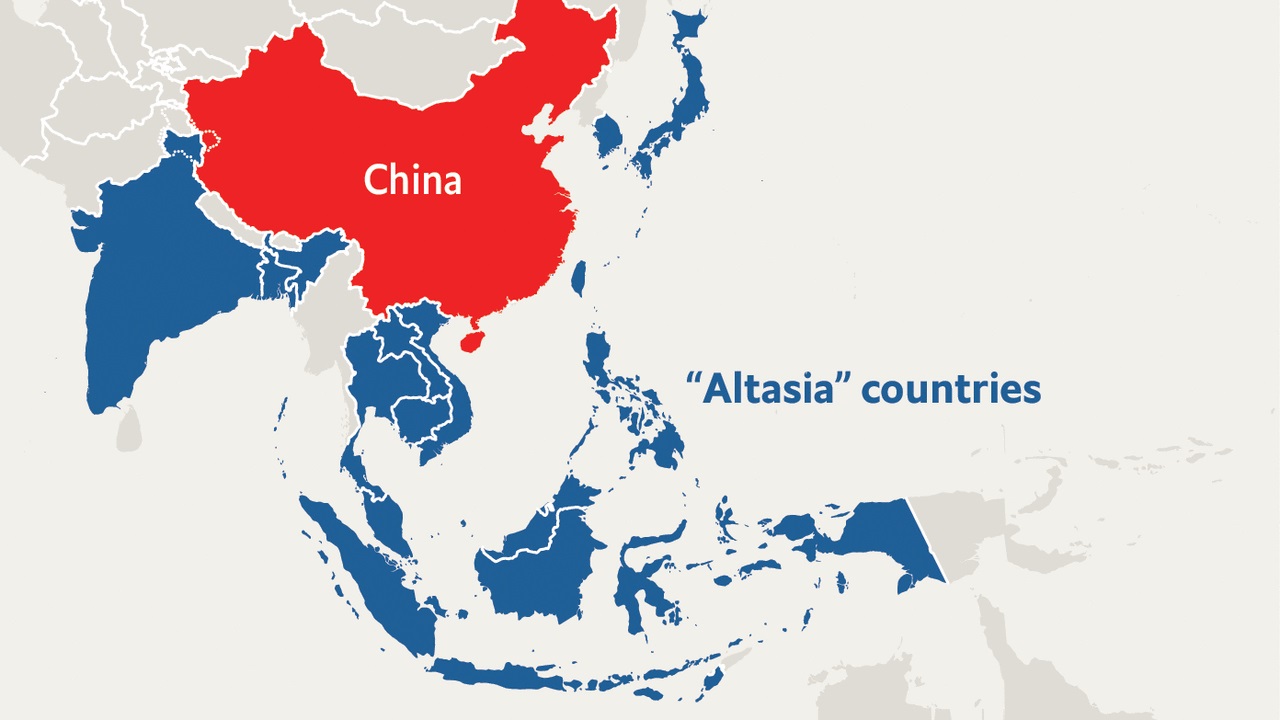
A escalada de tensão geopolítica entre China e USA tinha, necessariamente, de gerar consequências geoeconómicas. E estas começam a aparecer e a redesenhar os mapas... A Altasia nasceu neste emergente quadro geopolítico.


"Fourteen Asian economies are ready to replace China to be at the center of the global supply chain... Those economies - collectively coined as "Altasia" - include Japan, Taiwan, South Korea, India, the Philippines, Indonesia, Singapore, Malaysia, Thailand, Vietnam, Laos, Cambodia, Bangladesh and Brunei.

Though none of them can replace China as a single economy, the group could be competitive when global manufacturers look for new production bases outside of China in its geopolitical risks with US, said The Economist.

In terms of exports value, Altasia reported a total of US$63.4 billion (HK$494.5 billion) worth of goods to the US during the year ending last September, slightly higher than the US$61.4 billion of goods from China. But as electronics are the major exports from China, The Economist said not all Altasia members could provide competitive alternatives.

Meanwhile, Altasia members have a workforce of 155 million people aged between 25 and 54 with higher education, compared to 145 million in China.

The way to fully replace China is yet challenging, as Altasia members have differing infrastructure development, regulations and administrative practices in each economy.

Nonetheless, many companies have prioritized finding a supply chain alternative beyond China and will keep seeking new opportunities in Altasia."

https://www.thestandard.com.hk/section-news/section/2/250385/'Altasia'-making-moves-to-replace-'Made-in-China'

sábado, 4 de fevereiro de 2023

Ataque ao Império Adani: Como fazer desaparecer 100 mil milhões numa semana...

Parece uma estória saída de um exercício de um grupo de trabalho da minha escola preferida, a EGE (École de Guerre Économique), do tipo "como afundar a Walmart" ou "como reduzir a metade o preço das acções da empresa X". Só que não é apenas um exercício, é mesmo uma coisa real, que chega da India, como relata o L'Express:


Scandale Adani: comment le colosse indien a perdu 100 milliards de dollars en moins de 10 jours


Le 25 janvier, la jeune et modeste firme américaine Hindenburg Reasearch - nommée après le crash désastreux du Zeppelin en 1937 et connue pour s’attaquer à des sociétés de haut vol - publie un nouveau rapport explosif. Elle accuse le colosse Adani de fraude massive.

Elle affirme que l’entreprise a manipulé ses bénéfices grâce à des transactions non divulguées durant plusieurs décennies, pour "maintenir l’apparence de bonne santé financière et de solvabilité" de ses filiales cotées en Bourse. Selon Hindenburg, le frère aîné du fondateur, Vinod Adani, "par l’intermédiaire de plusieurs associés proches, gère un vaste réseau d’entités fictives offshore".

Le rapport pointe également la responsabilité du gouvernement qui, par son "indulgence à l’égard du groupe", aurait permis une fraude au grand jour, et empêché la presse et les institutions du pays de remettre en question le comportement du groupe Adani par "peur de représailles".

Cinq jours plus tard, l’empire Adani répond dans un rapport de plus de 400 pages à Hindenburg Research. Il y rebaptise l’entreprise américaine les "Madoffs de Manhattan", en référence à l’homme d’affaires américain véreux Bernard Madoff. Le groupe retourne l’accusation, et assure que cette révélation "est en proie à des conflits d’intérêts et vise uniquement à créer un faux marché de titres pour permettre à Hindenburg, un vendeur à découvert reconnu, de réaliser un gain financier massif par des moyens illicites au détriment d’innombrables investisseurs".

Après avoir nié la divulgation de transactions frauduleuses, le communiqué ajoute que "ce n’est pas seulement une attaque injustifiée contre une entreprise spécifique, mais une attaque calculée contre l’Inde, l’indépendance, l’intégrité et la qualité des institutions indiennes, ainsi que l’histoire de la croissance et l’ambition de l’Inde".

Seja como for, o diversificado e poderosíssimo grupo económico do homem mais rico da India e terceiro mais rico do mundo, viu 100.000 milhões evaporarem-se, numa semana. E isto foi só o início da tempestade...

Uma muito bem montada manobra de guerra de informação (não esquecer que a guerra de informação é hoje o principal fornecedor de instrumentos, métodos e técnicas à guerra económica e à guerra política...), que deve ter custado uns escassos milhões, permitiu certamente, a alguns felizardos, encaixes de largos milhares de milhões. Onde mais há investimentos com ROIs desta dimensão?

https://www.lexpress.fr/economie/scandale-adani-comment-le-colosse-indien-a-perdu-100-milliards-de-dollars-en-moins-de-10-jours-C6CYSNJSZND3PAHWRJRROYPYOQ/

terça-feira, 27 de setembro de 2022

Conflito na Ucrânia: Guerra Híbrida, Guerra de Informação e Dezinformatsiya

A guerra da Ucrânia não é uma "operação militar" ("especial" ou não), é uma guerra que se desenvolve, ao mesmo tempo, em vários tabuleiros e em que o "militar" pode nem ser (ou vir a ser) o mais importante, mas apenas o que serve para desencadear outras acções e outras dinâmicas que poderão tornar-se as decisivas, ou seja, uma espécie de detonador.


É, portanto, uma "hybrid war", como o  povo, as criancinhas e os políticos mainstream já começam a ver. Uma guerra híbrida que, como os manuais russos das últimas três décadas a concebem e definem, se desenrola, em simultâneo, nos tabuleiros da política, da informação, da economia e do militar, utilizando uma larga palete de técnicas e de metodologias para confundir, desnortear e desorientar o inimigo (mais do que para o vencer no campo militar). Uma guerra em que nada é proibido e tudo é permitido, tal como na versão chinesa, chamada de "Unrestricted Warfare"  (ver aqui: https://www.c4i.org/unrestricted.pdf).

A guerra de informação aqui desempenha um papel fundamental ao permitir moldar as mentes e os corações das populações do inimigo. A escola russa de guerra de informação sempre adoptou uma posição de "fraco" a enfrentar o "forte", sempre deu a primazia aos "conteúdos" e não, como a americana o faz, aos "continentes" e, desde há quase um século, desenvolveu como uma das  suas armas principais o que Estaline cunhou como "dezinformatsiya"... Caso exemplar e recentíssimo desta guerra de informação e da sua "dezinformatsiya" é o referido na foto acima. 

segunda-feira, 5 de setembro de 2022

Tempos de Guerra pela Hegemonia Global

 José Mateus

A potência marítima enfrenta, desde o início do século XXI, os mais sérios e perigosos desafios colocados, desde a II Guerra, pelos "chalengers" continentalistas. 

Este tempo é, portanto, como há anos venho a escrever, de decisiva disputa por uma nova hegemonia global e, consequentemente, por um novo modelo global.

Há anos, logo no início da passada década, chamei a atenção para a necessidade de bem ler o então ideólogo-mor de Vladimir Putin, em cujo sub-texto era possível descortinar já tudo o que veio a desenvolver-se e a que agora se chama "crise ucraniana". 

Infelizmente, às "elites" políticas ocidentais, enredadas em assuntos mais prementes, faltou o tempo para dedicar à leitura da "ficção política" de Vladislav Surkov. Falta de tempo que hoje pagamos caro, demasiado caro, incomportávelmente caro. Um preço que ninguém via desde a II Guerra.


Hoje, se Surkov continua a ser de leitura obrigatória, é absolutamente necessário, imprescindível mesmo, que as "elites" políticas ocidentais (ou, pelo menos, aqueles que são os cérebros dessas "elites"...) travem conhecimento com o ideólogo-mor de Xi Jinping e a sua obra capital, o "America Against America" do aterrador teórico principal do PCC, Wang Huning. 


Que a distração destas "elites" não se repita, espera-se.

quinta-feira, 28 de julho de 2022

Alemanha, o elo mais fraco da Europa

Sem energia nuclear, dependente da Rússia na energia e da China no comércio, a Alemanha parece cada vez mais o elo mais fraco da Europa.


sábado, 21 de maio de 2022

Japão: Nova Lei de Proteção da Economia

Na complexa, delicada e muito perigosa conjuntura estratégica que o mundo atravessa, o Parlamento japonês toma medidas para a proteção e segurança da economia do arquipélago.

Sheila A. Smith

Last week, the Japanese Diet passed a law to protect the economy from hostile actors.

This, along with a revision of national strategy and a long-term defense plan, will enhance Japan’s ability to navigate growing geopolitical tensions in the Indo-Pacific. 


Read more on Asia Unbound


quinta-feira, 28 de abril de 2022

Preparem-se para os impactos da guerra da Ucrânia

Choque triplo - reconhece o Washington Post - aumento dos preços dos combustíveis, aumento dos custos dos alimentos e turbulência financeira... Fuel, food, finance: Brace for impact from Russia’s Ukraine war

Os diversos Estados viverão, porém, este triplo choque de formas e modos muito assimétricos. 

Para os Estados frágeis o triplo choque será (está já a ser...) devastador... Desta questão o Washington Post pouco adianta. 

"The war’s disruptions stack on top of effects from the covid pandemic: disrupted supply chains, surging food and energy costs. That means empty shelves and inflation and, as governments strain to help their populations meet both needs, potential political upheaval.

"That, in turn, will ultimately threaten “America’s own security and economic well-being”...

As soluções de sobrevivência a encontar pelos Estados (sobretudo, para os mais frágeis que são a imensa maioria) vão passar muito (ou mesmo totalmente) pela geopolítica e muito pouco (ou mesmo nada) pelos "mercados"... 

Como diz o Peter Zeihan, este "fim do mundo é apenas o princípio". Portanto...


terça-feira, 1 de março de 2022

O Fim do Mundo É Apenas o Princípio... Mapeando o Colapso da Globalização

Peter Zeihan tem sido, desde há muito, uma das referências do IntelNomics, por isso é com muito gosto que apresentamos hoje a próxima obra do Peter: 

THE END OF THE WORLD IS JUST THE BEGINNING - Mapping the Collapse of Globalization


2019 was the last great year for the world economy.

For generations, everything has been getting faster, better, and cheaper. Finally, we reached the point that almost anything you could ever want could be sent to your home within days – even hours – of when you decided you wanted it.

America made that happen, but now America has lost interest in keeping it going.

Globe-spanning supply chains are only possible with the protection of the U.S. Navy. The American dollar underpins internationalized energy and financial markets. Complex, innovative industries were created to satisfy American consumers. American security policy forced warring nations to lay down their arms. Billions of people have been fed and educated as the American-led trade system spread across the globe.

All of this was artificial. All this was temporary. All this is ending.

In The End of the World is Just the Beginning, author and geopolitical strategist Peter Zeihan maps out the next world: a world where countries or regions will have no choice but to make their own goods, grow their own food, secure their own energy, fight their own battles, and do it all with populations that are both shrinking and aging.


The list of countries that make it all work is smaller than you think .....

Alea Jacta Est... Trump Manda Evacuar Teerão

Trump, 17.06.2025